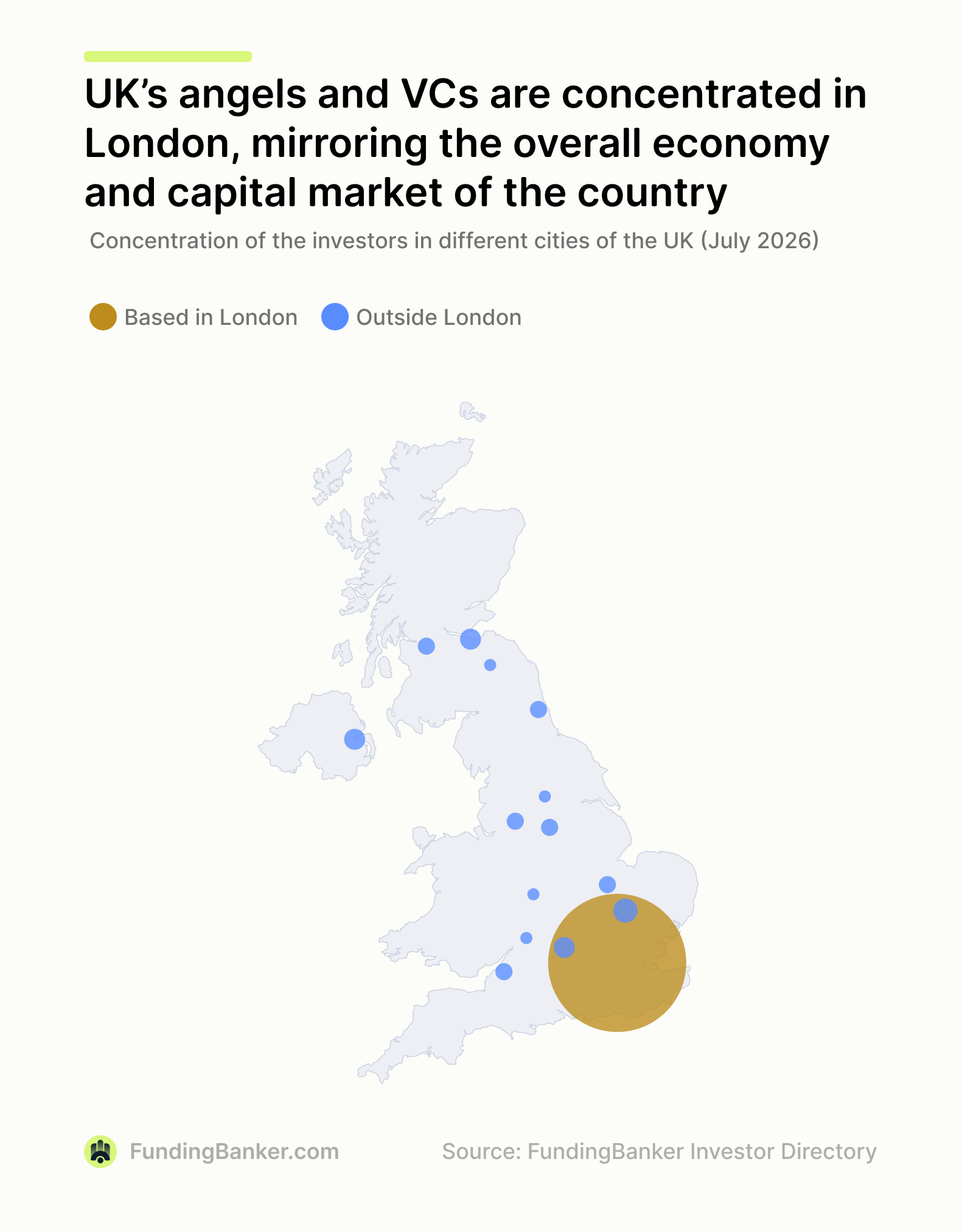
We ran an analysis against our investor directory on the 15th of July, 2026, analyzing the headquarters of the VCs and investors in the UK.
Here are the findings, as visible on the chart:
| Location | Percentage of investors |
|---|---|
| Based in London and/or the City of London | 82% |
| Outside London | 18% |
Some of the VCs had more than one office in the UK, and in those cases, we considered the location of their main office.
Why does this matter?
In 2023, the Financial Times released an analysis in which the GDP per capita of 4 countries was compared, with and without their richest regions. UK’s GDP per capita would drop 14% if London were removed, compared to 5%, 4%, and 1% for the Netherlands (without Amsterdam, the US (without SF), and Germany (without Munich), respectively. This result was a reiteration of the fact that the UK’s economy is highly dependent on London, at a much higher rate compared to other comparable economies.
The same fact is reflected in the startup capital market, where there are 4 times more investors in London than in the rest of the UK combined. This concentration will force every startup, at any stage, to be headquartered in London or have a significant footprint in London.
This concentration of capital and the startup ecosystem has created a feedback mechanism where the majority of capital is invested in London, more and more high-paying jobs are only found in London, and more opportunities arise in this market that are then solved only by London-based companies and teams.
Even though physical location may not seem that significant in our modern society, a large portion of startup capital is allocated through personal networks rather than cold approaches, which forces many founders to be physically closer to the capital.
Of course, some London-based VCs have secondary offices in other parts of the UK. However, interestingly, it’s much more common for a London-based VC to have a secondary office outside the UK than to have one in other parts of the UK.